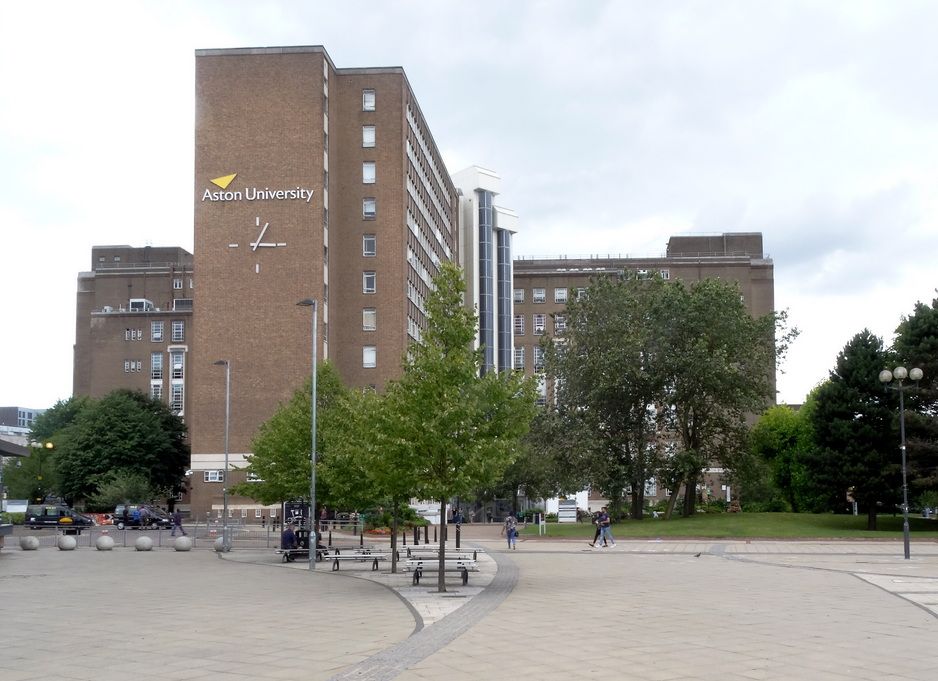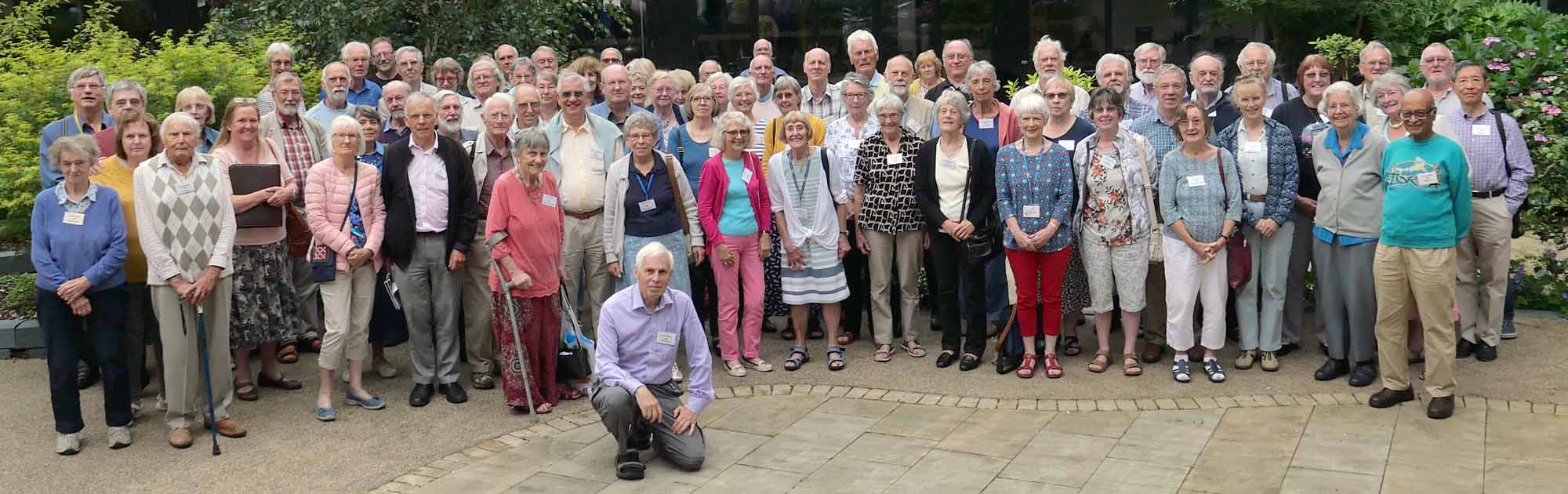
Aston Uni was a new venue for this annual meeting of the Science Network. It was chosen because it is centrally placed in the UK and there are plenty of places for group visits.
After registration and a quick coffee after a long journey by car we assembled in a meeting room to listen to Mike Hollingsworth welcoming us. Michaela Moody then checked who was going on the lab visits that afternoon and who had paid her for visiting the Think Tank.
We then dispersed accordingly.
Some twenty people went off to see Diego Faria who showed his Socially Assistive Robots and Intelligent Systems whilst others found their rooms.
Later Roger McFadden explained about the latest developments in Anti-Type 2 Diabetic drugs. Type 2 diabetes is caused by lack of vigorous exercise and excess sugar causing obesity. Some diabetes is genetic too. Now more younger people develop the disease than ever.
Diabetes is a complex disease and Roger showed some of the intricacies. Metaformin is used for overweight sufferers and is also used with more modern drugs such as Dapagliflozin. He mentioned the venom of the gila monster has been developed into an injectable drug (Exenatide). It works by increasing insulin release from the pancreas and decreases excessive glucagon release. It is an incretin mimetic stimulating the pancreas to secrete insulin when needed.
The Dangers of Texting and Walking with Jo Lumsden was a second lab visit for 20 more members. I did not hear about the outcome though.
 The next day the first speaker did not appear and Jill Gigg brought forward her talk about the Periodic table and how it developed. From Mendeleev, Lavoisier, Proust and Dalton. Berzelius used two letters to indicate each element eg Na = Sodium. Davy found Sodium, Potassium and Iodine, Silicon, Aluminium, Bromine et al. These all filled gaps in Mendeleev’s chart. Others continued this process including Dobereiner (triads sets), Cannizzaro had a Reaction apparently. In 1860 Robert Bunsen and Gustav Kirchhoff discovered two alkali metals, caesium and rubidium, with the aid of the spectroscope they had invented. This still goes on. The latest element is Ununennium, also known as eka-francium or element 119. Quite an eye opener. Ideal for University Challenge!
John Marriage came next talking about Liquid Amps or Electroplating. A lot of this happened in Birmingham specifically Elkington and William Canning. An example is shown of a silver plated set.
John mentioned Chrome plating and Electro-forming and Anodising. He introduced batteries as the reverse of electroplating. So he spoke about Lithium Manganese cells for watches and so on. Then Zinc-Air batteries used for hearing aids and pagers. And Thermal batteries for missiles because of long storage and instant output.
Paper rolling to make an armchair involved about 34 members. These were shown in their full glory during the Demonstrations evening. The maker of this one was very cautious.
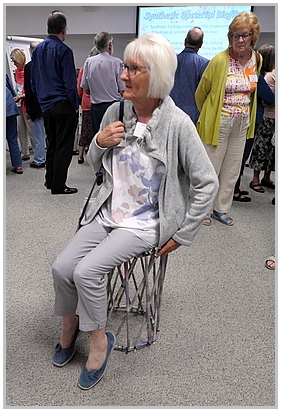
The Cybersecurity lab session was not up to a University standard according to some attendees. Non-attendees had the chance to see various videos on the topic later.
AI, Myth, Reality & Fantasy from F. Mahen Tempoe showed that intelligence is goal directed behaviour. Computers with intelligence can do this so help humans avoid drudgery. But the threat is it could make us dumb and dependent.
The Science of Frankenstein by Vernon Griffiths cleverly led us via the science prior to the book to put us in the frame to understand where Mary Shelley’s inspiration came from. The science that inspired Mary Shelley to write "Frankenstein" is nearly as strange as the novel itself. Written in 1818, the book was influenced by a scientific feud that ushered in the first battery and our modern understanding of electricity. But do not forget the Electric Kiss. Here an attractive young lady was charged up to a high degree of electricity by means of a hidden static electric generator. She then invited the arriving guests to kiss her. Just before the moment supreme,a strong discharging spark would jump between their lips. In effect rendering the kiss into a non-kissbecause the kiss would never really happen.
Also Priestly in Calne discovered 10 gases including Laughing Gas which had an eager following. Oxygen was described by one user as ‘Oh Excellent Air Bag!’ A good web page on the is https://tinyurl.com/y56tn25j.
The following day began with an inspiring talk from 2 Professors Alun Vaughan and Averil McDonald on “Are We Ready For Electric Cars?” They put things in scale to show how large the problems is and impossible some ideas are to implement on a global scale. The maximum UK electricity output is 60GW. Thus 1kW per person. So we will run out of capacity if we all use battery driven vehicles even if we balance the loads with a smart system. The best solution seems to be using Hydrogen for transport. Fuel cells would be in vehicles from cars to trucks and buses. The Hydrogen could be derived from Methane and a residue from this could be made into house bricks. Also H could be made from Cadbury’s waste products. Ships and Aircraft are harder to fuel without pollution. Electric aircraft would need high voltages but as aircraft ascend the air will breakdown more easily. This fact is omitted in most on-line articles on this topic.
See https://ready4ecars.southampton.ac.uk/ for about this.
Alun and Averil mentioned David Mckay’s Sustainable energy book. What he says in this book is good but governments have apparently not read to the end and missed the point that we are no anywhere near sustainable now.
It is on a free download http://www.withouthotair.com/. I urge you to read it.
Mike Hollingsworth Bramhall U3A and Subject Adviser for Science started a discussion group on the whys and wherefores of U3A Sci-Tech groups. A lively debate followed. Mike will absorb this and produce a new version of his PDF file on the main U3A web site under Resources.
Michaela Moody was doing a similar thing on reducing negative impacts on the environment.
Frederick Mahen Tempoe gave a second talk on AI and the Moral Dimension. AI is being improved a fast rate and he warned we must watch out for dispersal of advanced capability. We must balance fairness with sensitivity.
Philip Cheung Wadhurst U3A started his lecture with a video of a man playing a flute with a clarinet and a clarinet with a flute mouthpiece. The sounds were the clarinet sounded like a flute and vice versa. Wonderful. He then dived into realms of fifths and thirds and other parts of music beyond my mind.
Risk & Perception by Susan Slater Rugby U3A was fascinating. First in the book Norm Chronicles define the probability of death as a Mort. So Skydiving earns 8µmorts per jump. Taking Ecstasy is up to 13µmorts. Being born is 430µmorts.
Roundup has been banned and we now use copper sulphate which is very toxic used in its place.
Perception. Words in the media are often weasel words to make articles more dramatic. So beware of crisis, scourge, amid, surely and scientists.
In the press for 10 years or more we always have just days to save the NHS by picking the statistics to suit. Choose the right end points is used often.
Barath Rajan told us about Mysterious Water. After centuries of inquiries a full explanation of the properties of water is not forthcoming. There are so many anomalies with water. Such as the density of water in a capillary tube is higher than normal and is hard to freeze. Water has memory. Or does it. See https://tinyurl.com/y3qbox6j for proof.
Pure water Barath defined as having Conductivity 0.2µSiemens or less. In a glass of water near the glass is an Exclusion Zone [EZ] negatively charged and about 100µm thick. It has a hexagonal structure.
Other anomalies are that water cannot exist at temperatures between -40 and -120ºC; and there are 7 forms of ice.
Roger McFadden then told us about Monoclonal Antibodies. They are anti-cancer drugs that can be targeted to specific cancers by finding particular proteins. So different MABs have to be made to target different types of cancer.
The last talk was from Mike Trevethick Thanet U3A on Epigenetics called ‘Why doesn’t your nose grow an ear?’ Acetylation and Methylation are two ways of switching on and off genetic changes. Bees make use of this to make Queen bees. The use of Folic acid reduces Spina Bifida and is an epigenetic change. There is some control of cancer by using Ginger, Soya, Broccoli, Garlic, Citrus fruit and Egg Yolks. So the moral is Eat Your Veggies.
Peter Read – Subject Adviser Photography